Pages

Showing posts with label History. Show all posts

Monday, October 14, 2019

Christina Hollis: Writing History—Wet Washing and Drying Days

It's been raining cats and dogs here in Gloucestershire for days. While the downpour setting has swung backwards and forwards from "car wash" to "drizzle" it has at least been mild. The winds, though blustery, have been nothing compared to the terrible hurricanes and typhoons suffered in other parts of the world. I love letting the washing dry on a line strung across the kitchen garden, but there's been none of that this week.

My first few weeks back at university have been busy. I've been deciding on modules for this semester and the next, along with my ideas for my dissertation. One of the reasons I signed up for this course in Creative and Critical Writing  was because I found researching Struggle and Suffrage in Bristol fascinating. I wanted to find out more. Where better to do that than in a university? It  has zillions of books, and a huge archive.

I'm working on the effect technology had on women's lives during the twentieth century—specifically, the way it made household chores easier.

http://mybook.to/BristolWomen
Find out more at
mybook.to/BristolWomen
Until mid-December 1930, the wives of miners in the Forest of Dean didn't have one wash-day a week. They had at least five days of hauling water, and heating it on the stove in order to scrub their husband's work clothes. Men came home filthy at the end of their shift at the pit. After stripping off his boots and dirty clothes outside the back door, a man would soak in a tin bath in front of the fire in order to get clean.

Meanwhile, his wife had the mammoth task of getting his clothes clean and dry as fast as possible. That wasn't easy at a time when Forest villages had no electricity supply. There wasn't much money about in those days, so when it came to clothes the general rule was "one on, one in the wash". During the summer, drying clothes outside on a washing line was easy—until it rained. Then, and during the winter, it was a case of living with steaming wet washing draped over clothes horses and fireguards all around the house.

On Saturday, 20th December 1930, Christmas came early for some of those Forest of Dean wives. After months of anticipation, Cannop Colliery opened some state-of-the-art pit head baths. 

Instead of walking home filthy, men stripped off their wet clothes as soon as they reached the surface. They showered in comfort, then dressed in everyday clothes for their walk home. They left their sodden workwear to dry overnight in the bathhouse's specially-designed heated cabinets. From that day on, the women's drudgery of doing laundry after every shift down the mine became a memory. Washday became a task done once a week, usually on a Monday.

Not to be thrown out with the bath water...
In the days before my family bought a washing machine, that was the routine in our rural Somerset home, too.  It was an all-day job. Water was heated in an electric boiler.  Shirt and blouse collars and cuffs were scrubbed before being worked up and down in soapy water. 

Then the washing was rinsed, hauled out of the water, wrung, then put through the mangle (mind those fingers!) 

Even as a tiny child I was involved in every stage. I used to love blowing soap bubbles between my cupped hands. I wasn't so keen on getting wet cuffs, though. Gran would roll up my sleeves but somehow they either slid down again, or the water would run up my arms!

The best things about washing day before automation was the sound and sight of fresh washing cracking and dancing in March winds, or the fragrance of Fairy Snow and Sunlight soap on a hot June morning.

Do you have any memories of wash-day?

Christina Hollis's first non-fiction book, Struggle and Suffrage in Bristol is published by Pen and Sword Books. You can find out more about that here, catch up with her at https://christinahollisbooks.online, on Twitter, Facebook, and see a full list of her published books at christinahollis.com

Tuesday, August 15, 2017

Michelle Styles: Historical fact-checking can be rewarding.

People like their history to be the way they think it was. They tend to get upset when a historian or a historical novelist makes a change that  seems different than their perceived notion. It can be the things you think you know because they are widely accepted fact that can get you into difficulties.
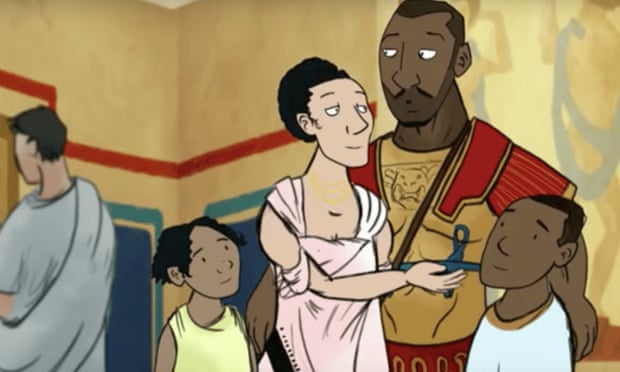
Recently there was a social media kerfuffle about a Roman British cartoon by the BBC. One of the characters was an African military officer supposedly serving in the Britannia. In one picture, he was flanked by his wife. Apparently people on the both sides of the Atlantic (who thought they knew history) screamed – Impossible, political correctness gone mad. Everyone knows Roman Britain wasn’t like that. There were no sub-Saharan Africans there and other such exclamations.
Photograph BBC
 I rolled my eyes. I have spent many hours along the Roman Wall, researching the period and I am happy to report that yes, there were African officers on the Wall. Some of whom may have their families (officially or unofficially) with them. There is a story that the Roman emperor Septimus Severus (a man with North African roots,  it was where the money was during the 2nd century AD) encountered an Ethiopian legionary officer when he arrived at the wall. There were others, including a troop of Nubian cavalry officers who probably were stationed at Chesters. (They may have been responsible for the re-dedication or rejuvenation symbol aka the phallus tile in the floor of the headquarters building which made my children giggle). The Roman Empire was ethnically diverse and they moved trouble-makers from one region to be soldiers in another, but Rome was not multi-cultural. When in Rome, do as the Romans do was an apt saying. It always surprises me when film-makers or other people depict Rome as one single national type. The Roman empire was huge and people did move about.
My problem with the cartoon was that having gone to the trouble to get the skin colour correct, was it too much trouble for the BBC to get woman’s costume correct? Her hairstyle and dress were all wrong for that era.  If you look at tombs of Romano-British women, particularly the famous Regina tomb, Romano British women tended to be all covered up in what has been termed a Gallic robe. Wearing something bare armed would have resulted in the woman being cold and several of tablets found at Vindolanda complain about the cold!  The woman on the tombs had big hair. But that is an aside. The BBC was right to point out that Roman Britain like the rest of the Roman Empire had many hues of skin contained within it. This is far better than assuming African people only really reached Britain after the World War 2 which some people myopically seem to think. 
One question is what happened to these African legionaries and possibly even merchants?  The short answer is we do not know.The large scale excavation of Roman cemeteries really has not happened. They could have served their time and retired back to their homeland. They could have retired in Roman Britain or even beyond the wall (the wall was more like a porous border control) and married local girls or other Romano-British inhabitants. They might have left when the legions left and the entire economy collapsed. Why stay in such a lawless and cold place? They might have been killed during the plague of 541 when approximately half the population of Britain, Europe and the Byzantium empire died. And some might have stayed and intermarried. There could be people whose families have been in the North of England for nearly two thousand years who had an African legionary as an ancestor and that is kind of cool to think about.

In short, checking facts can lead to interesting discoveries.  Given what passes for news these days, it can be helpful to go back to primary sources.  It is always useful to remember that history by its nature is always written through a dark and shadowy mirror and sometimes those reflections are not entirely accurate.

IN OTHER NEWS:

My latest Viking set historical romance THE WARRIOR’S VIKING BRIDE will be published by Harlequin Historical in March 2018. It features a Viking Shield Maiden and a Celtic warlord who has been sent to  return her to her long-estranged father. 

Michelle Styles writes warm, witty and intimate historical romances set in a wide variety of time periods from ancient Rome to the Victorian. Her most recent SOLD TO THE VIKING WARRIOR was set on the Western Isles of Scotland in 875. You can read more about Michelle and her books at her website www.michellestyles.co.uk. 

Wednesday, April 12, 2017

A Historical Hero - by Kate Walker

A long long time ago – too many years ago than I care to remember, I  first started to  get to know some of the history plays of Shakespeare.  There was a  television  series called  An Age of Kings  in 1960, one that lasted for 15 weeks, and which showed all  Shakespeare’s history plays one after the other.  One of those plays was Richard III  where Richard was shown as a violent,  cruel and conniving character.  That was how I first thought of him.  But of course Shakespeare was writing the sort of play that would please the royals of his time – the Tudor  dynasty who had  hated Ricard and fought to drive him from the throne.


Then two things happened – one was that I read a book by Josephine Tey called Daughter of Time in which a modern day detective, confined to bed in hospital, set out to investigate the case of those  ‘murdered’ Princes in the Tower as if it was a current day crime. His conclusion was that Richard of Gloucester was not guilty of the crime everyone thinks he committed. 

Then I went to the London Portrait Gallery  -  there I found a painting of the man himself. Richard didn’t look anything like the cruel and violent killed of Shakespeare’s portrayal . His portrait showed a man who was too old for his real years -  Richard was only  32  when he died. That’s the sort of age of so many of my heroes when they are really just beginning their adult lives.   This painting  also made  the  king look like a man worried by life, taking a lot on his shoulders.   He didn’t look like the monster he was painted. 

As a result, for years I’ve been fascinated by this intriguing character.  I read  so many other books – fiction like Sunne in Splendour, We Speak No Treason,  and  factual books  to try and get as cl
ose to the truth as I could.  I even joined the Richard III Society – and when I met my husband, I found that he too was a member of that group, someone who believed that Richard had been maligned.
Daughter of Time in which a modern day detective, confined to bed in hospital, set out to investigate the case of those  ‘murdered’ Princes in the Tower as if it was a current day crime. His conclusion was that Richard of Gloucester was not guilty of the crime everyone thinks he committed.

Back then we never expected that the exciting discovery of ‘The King in The Carpark’ would ever actually happen. We were excited  when the archaeological dig in  - of all places  - a Leicester carpark discovered the remains of  a man, buried there long ago. Even  more exciting, tests and DNA examination proved that this was in fact the skeleton of  Richard III himself,  killed at the Battle of Bosworth and buried hastily in an ancient abbey.  They even managed to do a facial reconstruction to show what he might well have looked like in  life
Last year there was a ceremonial funeral for this long-lost king. He was buried in Leicester Cathedral with the sort of ceremony he never had  back in  1485.   Because of my interest in his story, and my fascination with the man I promised myself – and my husband – that one day we would go and visit the tomb in Leicester Cathedral.  So that’s where I’m going today. 


All those years ago, I never expected that the  king’s remains would be found – the story was always that his body had been thrown into the river and washed away.  So it will a poignant moment to actually see where he is buried. It won’t give me any further evidence as to the truth of who really actually murdered the
Princes in The Tower (if in fact they were actually murdered ) but it will be a special sort of a pilgrimage and a suitable closure to a story that has fascinated me for years.

I am so looking forward to it

Do you have a historical character who fascinates you like this?  Or something that you have  long wanted to do that you have finally managed to achieve? 

You can keep up to date with all my news on my web site blog page  or my Facebook page   where you can find out when I have new books appearing in the shops.


Wednesday, February 15, 2017

Michelle Styles: Upending history

One of the things about history is that while we think it is very settled and we know what went on, every now and then, a new discovery changes things.
So it proved earlier this month when my copy of the Smithsonian magazine arrived. My sister has had  it sent to me for about 15 years because she became tired of thinking  oh Michelle would find this fascinating and sending me the article.
This month's magazine had an article on a recent archaeological dig that had supposedly up ended what  was currently known  about the Minoan civilization and Mycenaean and their relationship to each other..  Because I have a long standing interest in this time in history, I rapidly read the article and my jaw dropped. A bit like how Howard Carter found the  tomb of  King Tutankhamen, this dig led by a husband and wife from the University of Cincinnati found an undisturbed tomb of a high ranking early Mycenaean  back in June of 2015 at Pylos on the Greek mainland.
Bull's head from Crete
The problem with looking at anything in this time period and trying to figure out what went on is a bit like trying to  do a jigsaw puzzle with about 40% of pieces missing. The resulting picture depends a great deal on the skill of the person interpreting  the pieces and sometimes what was though to be a piece of  sky is actually a piece of water or even something else entirely. This tomb adds greatly to the number of pieces that are available.
The story of how they found it  reads a bit like an adventure story   problems with permits meant they were unable to dig where they wanted and settled for what they thought was second best, the season had been okay but not great and was coming to a close and then they discovered it. Rather than finishing at the beginning of June, the dig was completed in November.
Throne room from Knossos
Because context is all, they painstakingly recorded how the grave was set out and what grave goods went where. (This is something that  was missing from many of the early digs -- for example Harold Evans at Knossos) And what grave  goods they were --- gold and silver cups, a variety of rings, beads made from precious stones and more than 50 seals with a skeleton of a man at the bottom, more than 1500 object in all. Included In short, it is probably the most significant find in Greece in the last 50 years.
One of the enduring mysteries about this time is  how much interaction is there between the Minoans on Crete and the Mycenaean on the mainland. Of course, the story of how Theseus  conquered the labyrinth, and destroyed the Minotaur is one of the world's great legends.  But no one knows the precise relationship between Mycenae and the Minoans. There has been much speculation, particularly after  Linear B was  finally decoded in the 1950's, but no one knows for certain. 
Because of how the grave goods were placed, it shows that the people doing the placing knew what the Minoan objects from Crete were used for. That is probable, the two civilizations co-existed together peacefully for a time and there was much trading.
Then in the summer of 2016, the same team made more discoveries on the site, including fragments of wall paintings which were done in the Minoan style. In other words, maybe the experts have had it wrong and that Minoan civilization wasn't completely wiped from the face of the earth. It seems probable with the new evidence that is emerging, the ancient Greeks owe their unique brand of government or democracy to  both the Mycenaeans and the Minoans intermingling. If so, then the roots of civilization will be altered. However, if one is writing historical fiction, one sometimes cannot use the cutting edge theory because it is more about creating a believable world.
So if writing about Theseus and the Minotaur, the old norms would still have to prevail. Even if this discovery holds the tantalizing possibility of upending everything we thought we knew.

Michelle Styles writes witty, warm and intimate historical romance for Harlequin Historical. Her latest SOLD TO THE VIKING WARRIOR is out now. You can read more about Michelle and her boks on www.michellestyles.co.uk 

Tuesday, May 20, 2014

Historical Accuracy vs Literary License?

   
Nothing starts arguments on writers' loops and email groups faster than the discussion about whether writers - especially of historicals - can change history or the facts or not? Over the weekend, I presented a workshop to writer about this topic....and the discussion was. . . lively!

   I know when I was only a reader - before the need to tell stories struck - I loved learning historical tidbits and then going off to find out more. An unfamiliar place or king. Something I'd never read before. An intriguing bit about a historical event. All of those would send me looking for more information. And spending hours and hours reading about those bits. And remember, this was mostly before the internet, so it meant going to the library or looking in (shocking!) the encyclopedia! 

   I didn't mind if I discovered the author had changed something, not if the storytelling had kept me turning pages, unable to stop reading. I liked the occasional challenges and the intriguing lure of more facts to learn. 

And then I became a fiction writer and I needed to decide how I would approach all that alluring REAL history when writing my stories. 

My decision -- to know the real history but to change, mold, twist, revise it as needed to make my story work!  BUT - in deference to those who are offended by that approach, I do add an Author's Note to explain any liberties I might have taken....

How about you? Do you get twitchy when an author goes rogue and changes history? Do you care if it's accurate if the story has held you prisoner or only when glaring changes or errors happen? 


Terri is thrilled that her current book is being featured in many retails stores along with bonus content. And, her last book - The Highlander's Dangerous Temptation is being promoted for the next two weeks at a special price - 99¢!! Visit her FB page or profile for more info and links!