Pages

Showing posts with label #weneeddiverseromance. Show all posts

Sunday, July 15, 2018

Michelle Styleas: The #RomanceIncludesYou blitz opportunity for aspiring authors


In case you haven’t heard, Harlequin is currently doing an across all the lines submission blitz for underrepresented authors  --#romancesincludesyou. Authors who feel they are from underrepresented communities but are writing stories which fit Harlequin series guidelines have been invited to submit the first chapter and a synopsis between 11 July 2018 and 2 September 2018 with guaranteed feedback by 1 October 2018.  It should be stressed that the normal submission process (i.e. the one most authors have gone through) remains open to anyone to submit – that is the first three chapters plus a synopsis but with no guaranteed response date.
Harlequin is deliberately not defining underrepresented but if you look at #ownvoices, you will get an idea of what they are looking for. Basically there are some authors who have not bothered looking at or submitting to Harlequin because they wrongly feel a traditional publisher would not be interested. Publishers’ guidelines are always changing and Harlequin in the last year for several reasons has greatly widened its remit. It has gone from tacitly seeking to actively seeking diverse voices.  But those voices need be producing stories which fit the guidelines in other respects. In a drive to get these sorts of stories, the editors have initiated this blitz to raise awareness that they are actively seeking these stories.
For example, with Harlequin Historical, the eras which have the most global appeal are Georgian/Regency/Victorian, Medieval, Highlander and Viking. But how to get diverse voices in there? It means actively seeking out high status people who have been airbrushed from history. 
 In the late 18th century, John Perkins became the first black/biracial commissioned naval officer in the Royal Navy. The first black US commissioned naval officer did not happen until 1922 – over a 150 years later.   Perkins also was one of the highest prize- winning captains of his era as well as serving as a spy. The way naval officers became wealthy was through capturing ships and winning prizes. But he has been overlooked by many people.  Last month I went to the Maritime Museum of Liverpool’s Black Salt exhibit about black sailors in Britain, he had a two line mention --- I am not sure why as his story is fabulous.  British naval officers have been  mainstay heroes of the historical line for a long time, and a black British Regency naval officer is a fact of history, not some sort of multi-cultural fantasy. All it takes is one -- as authors of governess to duchess stories know.
 When I mentioned this on twitter, a Jamaican aspiring author said that she was tempted to use Perkins as a template for her hero but her feeling was no traditional publisher would be interested. I tried to gently explain that my gut instinct, having written for Harlequin Historical, was that the editors would be very interested, but they can’t buy these stories unless authors submit them.
Another overlooked Regency figure was Sake Dean Mahomed, an East India Company captain who became the first man to open an Indian restaurant in London (1810) and then he introduced the concept of shampoo (Indian head massage) to the Britain and the Western world through his spa in Bath and a well-respected member of that Regency community.  He also eloped with an Irish girl of respectable parentage when her parents objected to the match. The family settled in Bath and became wealthy off the spa trade. His grandson Frederick Akbar Mahomed became a famous surgeon at Guy’s Hospital in the Victorian era, making important contributions to the understanding high blood pressure as well as helping to pioneer what is now called collaborative clinical trials. Both these men could make excellent templates for diverse heroes for the historical line.
With Vikings, recent archaeological research has uncovered  a sub-Saharan Africa  woman buried in a cemetery dating from the era. The fact that she was buried points to her being fairly high status.  How or why she came to live in England is anyone’s guess but I suspect there was a romance involved.
I could go on and on about the possibilities but it is up to other authors to uncover these stories and tell them but Harlequin Historical is looking for stories with diverse characters as indeed are the other lines. You have to take the editors at their word on this.
So if all this intrigues you, go check out the Romance Includes You Blitz and submit your first chapter and synopsis before 2 September 2018. 
If you are not from an underrepresented group but really want to submit to Harlequin or do not feel your story will be ready in time, go through the normal channels and submit. They are always open to submissions and do buy from the slush pile
 NB I was bought from the slush pile so am perhaps biased in favour of this method but do not let anyone put you off from submitting by saying -- they don't buy... if you think your story fits their guidelines. My first book for them was a Roman era romance and at the time I submitted, they had not bought such era.

Michelle Styles writes warm, witty and intimate historical romances for Harlequin Historical in a wide range of time periods including Viking. Her most recent The Warrior's Viking Bride was published in March 2018. Her next Viking set romance Sent as the Viking's Bride will be published in January 2019. Her first published HH was The Gladiator's Honour (2005) and was the first time Harlequin had published a romance set that era. You can learn more about Michelle and her books on www.michellestyles.co.uk 

Saturday, October 14, 2017

Michelle Styles: Hidden Histories

In 1866 Malinda Russell self-published a cookbook containing useful receipts for the kitchen  in the hopes of raising enough money so she could return to Tennessee and attempt to reclaim her property, property she’d been forced to leave behind when she’d fled Northward due to her Union sympathies. Malinda Russell was a Woman of Color, born free by law because her mother Karon had been born after her grandmother, also called Malinda Russell, was emancipated. The US slave system was descent down the maternal line based, a particularly noxious form of slavery which still exists in some African countries (see www.antislavery.org for the definitions of  modern day slavery). It is notable that she does not mention her father's or grandfather’s status. She also doesn’t mention any aunts or uncles who might have been born prior to her grandmother obtaining her freedom and what their status was.
Her book was the first cookbook published by an African-American woman and one of the very few cookbooks which authentically details Southern plantation cooking and as such is a hugely important primary source document. While she mostly focuses on cakes, Russell also includes recipes for cordials and preserves, how to make eggs last longer and how to make various medical ointments. My love of old cookbooks is such that I spent a morning happily enthralled reading the free digital version of her book.
Malinda’s life story reads like fiction – as a teenager she tried to emigrate to Liberia but was robbed and forced to obtain work as a laundress in Lynchburg VA and there she learned how to cook. She married but her husband died, leaving her with a disabled son and so she ran a boarding house in a spa town in eastern Tennessee  and then for  6 years successfully ran a pastry or cake shop until the American Civil War forced her to start over in Michigan. Among other things she was robbed of her considerable life savings by a Guerilla band who threatened her with death if she revealed their names.  I do hope she did raise enough money to return to Greenville Tennessee and reclaim her property.
 I love reading and writing about women with indomitable spirits who struggle against the odds and succeed but Malinda's is not a story I can tell. Thankfully there are other writers who can. At the moment they are often marketed as African-American historical romance writers but they are really saga writers in the tradition of Catherine Cookson, that great doyenne of British woman’s historical fiction who famously claimed she didn’t write romance (meaning books like Barbara Cartland wrote).  Other British saga writers include Josephine Cox, Benita Brown and Penny Jordan when she was writing as Annie Groves as well as Winston Graham who wrote Poldark.
British saga writers differ from historical romance writers in that historical romance writers like me tend to focus on heroes who are of the first estate with the emotional growth of the relationship being the primary focus, whereas saga writers tend to have the heroes being working or lower middle class (the villains are often weak men of the first estate) and the romance is often secondary to the woman’s personal growth. Sagas are sometimes in UK publishing parlance known as Clogs and Shawls or Rats and Rickets books.  When I first moved to the UK, the saga reigned supreme in the UK publishing world with Mills & Boon being basically the only publisher to publish the sort of historical romance I had enjoyed in the US. It wasn’t until more than a decade after she published her last book that Cookson ceased to be the most checked out author in the UK library system. Before I moved from California to Northumberland, I read a lot of Cookson so I could better understand my new home and grew to enjoy this sort of writing.
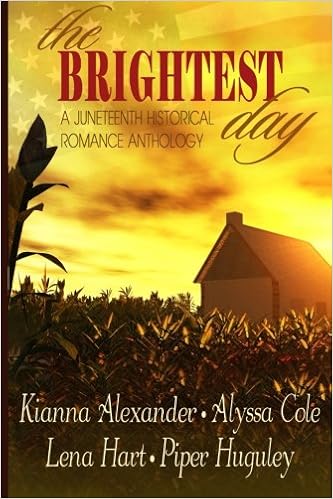
If anyone else like me loves reading about indomitable women who overcome great odds to thrive,  Alyssa Cole and Piper Huguley write excellent historical sagas. There are other American saga writers but I really enjoy these writers’ novels. They both contributed to The Brightest Day: A Juneteenth Anthology which I was privileged to read before Alyssa Cole  received a Rita nomination for  her novella Let It Shine. That anthology can be a good place to start to get a flavour of the books available. Piper Huguley’s Milford College series is also excellent (her prequel The Lawyer’s Luck is free to download). If you enjoy reading Catherine Cookson or Annie Groves (Penny Jordan), you will love Piper Huguley.
 My only regret is that because these books are often marketed African-American historical romance and shelved in the African American section of booksellers that they can be overlooked by readers who go to the romance/women's fiction section, looking for such books which illuminate hidden bits of the American experience and feature strong heroines.  I am firmly of the view that we need diverse romance and that all romance should be shelved together, not softly segregated by skin colour.

Michelle Styles writes warm, witty and intimate historical romances for Harlequin Historical in a wide range of time periods. Her next Viking-set romance, The Warrior’s Viking Bride, will be published in March 2018. In her free time, she loves reading all sorts of romance because it affords her the opportunity to walk in someone else’s skin. You can read more about Michelle and her books at www.michellestyles.co.uk